
Complete Guide to Chain Brand Store Music Copyright Compliance

1. Core Legal Framework for Store Music Copyright
All offline commercial stores (restaurants, retail, beauty, supermarkets, tea shops, etc.) that publicly play background music are engaging in commercial public mechanical performance acts. This does not fall under personal fair use and requires legitimate commercial authorization. The key applicable laws are as follows:
- Article 10 of the Copyright Law: Explicitly defines performance rights (including mechanical performance rights). When stores broadcast music publicly to unspecified consumers through audio equipment, this constitutes a legally recognized use of musical works, requiring authorization from the songwriters and composers.
- Article 45 of the Copyright Law (revised and effective in 2021): When stores publicly play recorded products, in addition to the lyrics and music authorization, they must pay remuneration to the recording producers (record labels). Both are indispensable.
- Article 54 of the Copyright Law: Infringement compensation standards are calculated based on actual losses, infringement profits, or authorization fees in sequence; if unascertainable, statutory compensation ranges from 500 RMB to 5 million RMB. For willful infringement, 1-5 times punitive damages may be added. Attorney fees, notarization fees, and litigation costs for rights enforcement are borne by the infringing party. For chain multi-store infringement, compensation is calculated cumulatively based on the number of stores and duration of infringement.
- Copyright Collective Administration Regulations: MCSC and CAVCA are the only officially recognized music copyright collective management organizations in China. They have the authority to collectively manage copyrights, issue public broadcast authorizations, collect copyright fees, and initiate rights enforcement lawsuits. Enterprises cannot circumvent the official compliance system.
Key Compliance Misconception: Personal mobile app subscriptions, legitimate CDs, and downloaded music are only suitable for private personal enjoyment. They cannot be used for commercial public broadcast in stores. Personal authorization and commercial authorization are completely separate.
2. Chain Store Music Infringement Risks and Consequences
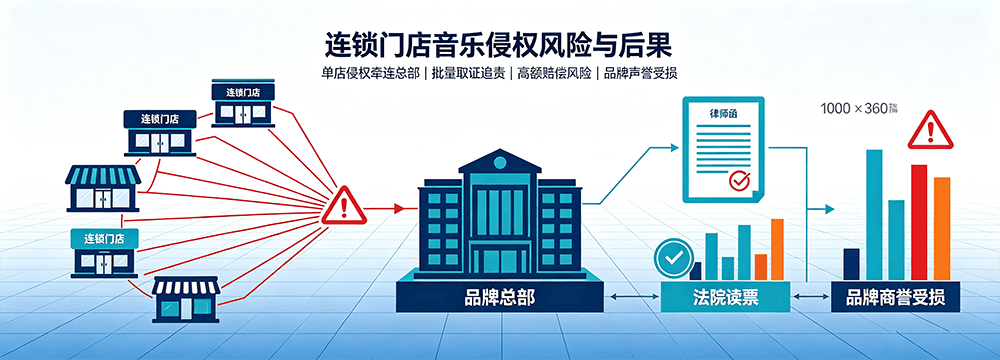
Infringement at a single store of a chain brand can implicate the headquarters, causing three types of harm: batch risks, brand public opinion issues, and economic losses:
- Hierarchical Rights Enforcement: First, you will receive infringement warning letters and attorney letters. If not rectified within the deadline, batch notarization and evidence collection will be conducted, leading to direct lawsuits against both the store and the brand headquarters.
- High Cumulative Compensation: A single store may be ordered to pay compensation ranging from several thousand to tens of thousands RMB. For a chain with hundreds of stores, infringement can accumulate to hundreds of thousands or even millions in compensation. The longer the infringement persists and the more stores involved, the higher the compensation.
- Brand Reputation and Franchise System Damage: Litigation documents are made public online, affecting brand reputation, investment and financing, franchise recruitment, and easily triggering franchisee trust crises and termination disputes.
- Continued Infringement Aggravates Liability: If infringing music continues to be played, the infringement state persists, the statute of limitations does not suspend, and subsequent accountability can be traced back to the entire infringement period.
- Regulatory Administrative Penalty Risks: For willful circumvention of copyright and long-term refusal to rectify, you may face administrative penalties from copyright regulatory authorities.
3. Two Store Music Authorization Models: Association Copyright vs. StoreSound Third-Party Copyright
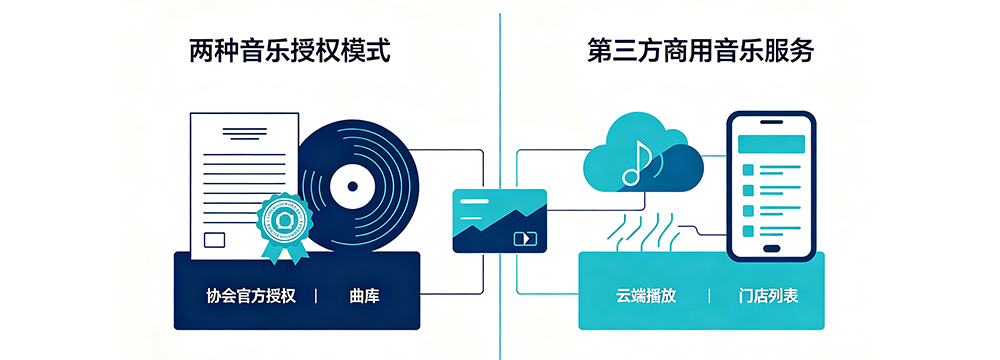
Currently, there are only two legitimate authorization paths for store compliance. Either one can complete compliance. Headquarters can flexibly choose based on brand development stage, store scale, and music needs. Here is a precise comparison across core dimensions:
| Comparison Dimension | MCSC + CAVCA (Official Association Copyright) | StoreSound Third-Party Commercial Copyright (Service Provider Model) |
|---|---|---|
| Authorization Catalog Scope | Covers over 95% of popular songs, hit classics, Hong Kong/Taiwan and overseas tracks across the network. Most comprehensive catalog with no content gaps. | Service provider's own licensed legitimate catalog, focusing on light luxury, trendy, brand-adapted pure music, and compliant popular tracks; does not include hot exclusive hits controlled by the dual associations. |
| Pricing Model | Official standardized pricing, calculated based on store type + business area. Uniformly published nationwide, fixed with no negotiation space (agency may negotiate moderately). | Flexible market-based pricing, calculated based on number of stores, service period, and catalog level. Better cost-performance for chain bulk purchases. |
| Billing Rules | Package authorization, no limit on the number of songs played or duration of play. Playing 1 song costs the same as playing 10,000 songs. | Billed based on authorized service scope, fixed catalog, fixed store usage, no hidden fees. |
| Core Service Content | Only provides copyright compliance authorization, no playback control, playlist operation, or store management services. | One-stop full service: legitimate copyright authorization + hardware playback devices + headquarters cloud unified management + exclusive playlist customization + scheduled playback + one-click song switching risk control for all national stores. |
| Brand Adaptability | No customization service, general catalog, cannot match brand tone or store scenarios. | Supports brand-exclusive auditory system, can customize exclusive playlists by store scenario (front hall/kitchen/peak hours/off-peak hours), creating differentiated brand auditory IP. |
| Chain Control Capability | Single-store independent authorization, headquarters cannot manage or control uniformly, store playback is unstandardized. | Headquarters super control dashboard, 100% unified national store music content, playback time, and music style standards, preventing stores from privately playing infringing music. |
4. Detailed Explanation and Core Differences Between MCSC and CAVCA
4.1 Music Copyright Society of China (MCSC)
An official collective management organization approved by the National Copyright Administration, it primarily manages lyrics and music composition rights (the creative rights of lyrics and melodies), covering the vast majority of domestic songwriters and globally recognized musical works. Public broadcast of music in stores must obtain its mechanical performance rights license, which is one of the basic rights for store compliance.
4.2 China Audio-Video Copyright Association (CAVCA)
An official collective management organization approved by the National Copyright Administration, it primarily manages the neighboring rights of recording producers (copyright of finished audio recorded by record labels). According to Article 45 of the 2021 Copyright Law, publicly broadcasting finished recordings in stores requires completing remuneration payment authorization through CAVCA.
4.3 Summary of Core Differences Between the Dual Associations
- MCSC = manages "songwriters" (lyrics and music copyright), solves the public performance authorization for melodies and lyrics;
- CAVCA = manages "recording companies" (recording copyright), solves the public broadcast remuneration authorization for finished audio;
Compliance Key: To play any legitimate recorded song in a store, you must obtain authorization from both associations simultaneously. Association authorizations on the market are all "two-in-one package authorizations" that resolve both copyright issues at once.
5. Chain Brand Headquarters Copyright Solution Selection Guide
5.1 Brands That Should Prioritize "StoreSound Third-Party Copyright"
National chains, multi-store operations, rapid store expansion, emphasis on brand standardization, need for proactive risk prevention, no mandatory requirement for playing all popular hits, and desire to create exclusive brand music tone. The core value is: unified control first, then compliance as a backup, risks can be quickly contained.
5.2 Brands That Should Prioritize "Dual Association Official Copyright"
Few stores, no unified control needs, business scenarios requiring high-frequency use of popular hit songs and viral tracks, and brands with extremely high requirements for music content richness.
5.3 Optimal Combined Solution for Chain Brands (Common for Leading Brands)
StoreSound system (unified control + risk control + playlist customization) + Association copyright (full coverage of popular catalog), balancing brand standardized management, full catalog compliance, and emergency risk response, completely resolving chain brand copyright disorder.
6. Frequently Asked Questions at Brand Headquarters
Q1: A store receives an association copyright infringement notice. How should the headquarters handle it urgently?
- Immediately stop the loss and prevent risk expansion: Use the StoreSound backend to one-click stop and switch all infringing tracks across all stores, terminating the continuous infringement state. This is the core key to reducing compensation and avoiding escalation to litigation;
- Rapidly assess brand music needs: If popular hits are not needed, directly switch to StoreSound's legitimate catalog to complete full compliance; if daily operations must use association popular tracks, you can use StoreSound's agency service to negotiate with the association for more favorable batch authorization fees, avoiding high single-store signing costs;
- Retain all rectification records: Save evidence of song switching, rectification, and authorization communications for subsequent settlement negotiations and reducing compensation amounts. Never ignore the letter directly to avoid batch lawsuits.
Q2: Why wasn't the brand required to purchase full copyright in the early stage?
StoreSound actively informs brands about store music copyright risks and provides compliance suggestions in all project proposals. The final decision is made by the brand based on its development stage. Commercial music copyright compliance in China started late, and overall industry awareness is weak. In the early stage of brand expansion, budgets and focus are concentrated on store expansion, decoration, merchandise, and staffing, making copyright compliance a lower priority. Most brands choose a phased strategy of "first building a music control system, unifying store playback standards, and then completing copyright when the scale matures." The core value of the StoreSound system is to reserve risk control backup capability, allowing one-click switching to compliant catalogs at any time, quickly terminating infringement, and adapting to the phased compliance development needs of brands.
Q3: How is store music copyright specifically billed?
1. Dual Association Copyright: Publicly available standardized pricing on official websites, strictly calculated by store type and business area tiers. Package authorization unlimited by songs and duration, uniform national standards, no arbitrary pricing;
2. StoreSound Third-Party Copyright: Flexible market-based pricing, customized quotes based on brand store count, authorization period, and catalog version. Better cost-performance for chain brand bulk purchases, no hidden fees.
Q4: If a store only loops 1 association-managed song, how is it billed?
The association uses a package overall authorization model, not billed by song count or playback duration. For stores of the same type and area, playing 1 song and playing tens of thousands of songs have exactly the same authorization fee.
Q5: Is using AI music completely free of copyright risks?
Not risk-free. AI music is a common pitfall for brands, with three core risks:
- Training data infringement: Most AI model training materials contain a large number of copyrighted commercial songs, and generated tracks are likely to be substantially similar to existing works, constituting infringement;
- Authorization scenario restrictions: Most AI music commercial authorizations only support online use, not including offline store public broadcast scenarios, and cannot be directly used for store playback;
- Significant ownership disputes: AI-generated content has no clear and stable judicial confirmation standards, no official compliance endorsement, and is prone to rights enforcement disputes;
Conclusion: Stores can only use legitimate AI catalogs explicitly marked with "including offline store public broadcast commercial authorization." Free online AI audio is prohibited from commercial use.
Q6: If a store has obtained offline public broadcast authorization, can it be directly used for brand online short video/livestream background music?
Absolutely not. This is a typical rights misuse infringement. Offline store public broadcast corresponds to mechanical performance rights, only applicable to offline physical store scenarios; while online short videos, livestreams, and brand promotional videos correspond to broadcasting rights and information network dissemination rights, which are completely independent copyright categories and not interchangeable. Even if a store has full offline copyright, using it for online promotion, livestream drainage, or short video publishing still constitutes infringement, and a separate online scenario authorization must be purchased.
Q7: If you directly sign authorization with singers, authors, or record labels individually, is it absolutely compliant?
Not necessarily. This approach has extremely high risks, and brands cannot control it independently, easily obtaining invalid authorizations. According to the Copyright Collective Administration Regulations: once songwriters or record labels join MCSC/CAVCA, all their works created and to be created in the future are automatically brought under unified management by the associations. Individuals and companies have no right to issue public broadcast authorizations independently. At this point, if a brand directly signs with authors or record labels, it constitutes a duplicate authorization by the other party, which is completely invalid in law, and the association will still pursue claims later. Ordinary brands cannot verify whether copyright owners have joined the associations or whether works are under association management. They must rely on professional third-party service providers (StoreSound) for copyright ownership verification to avoid invalid authorization risks.
Q8: If a franchise store infringes, who is the subject of copyright accountability? Is the brand headquarters responsible?
- The direct infringing subject is the actually operating franchise store (actual playback, actual business profit);
- The brand headquarters will definitely bear joint responsibility: because stores use the brand trademark and brand unified operation system, the brand entity will be directly included in the lawsuit in judicial proceedings, and single-store infringement will implicate the brand's overall reputation and compliance risks;
- Optimal solution for headquarters: Establish a unified copyright compliance system for all stores, uniformly control music content, fundamentally prevent franchise stores from privately playing infringing music, and avoid joint liability risks.
Q9: Can personal music subscriptions, legitimate CDs, or downloaded music be used for store playback?
Completely prohibited. The authorization agreements for all personal music products explicitly limit use to "personal non-commercial private enjoyment" and explicitly prohibit commercial public broadcast. Commercial use in stores constitutes unauthorized use beyond the scope, 100% constituting infringement, and cannot be exempted.
Q10: Does playing pure music or instrumental BGM without lyrics in stores require copyright?
Yes. The melody and arrangement of pure music are protected musical works, and the finished recordings belong to recording producer rights. Regardless of whether there are lyrics or vocals, as long as it is publicly commercially broadcast, corresponding authorization must be obtained, with no room for exemption.
Q11: If the headquarters uniformly purchases copyright, are all franchise stores automatically compliant?
Not necessarily. Copyright authorization strictly follows the "authorization scope matching principle." The contract must explicitly state: the authorized scenarios include all offline directly-operated/franchise stores of the brand and commercial public broadcast use. If the authorization is only limited to online use or only directly-operated stores, franchise stores remain in an infringing state. Third-party service providers can provide unified authorization based on the brand's total store volume to achieve full compliance.
Q12: If a store plays music from TV or radio, can it be exempted from liability?
No. Copyright compliance only considers whether the usage scenario is commercial public broadcast, unrelated to the audio source. As long as the store publicly plays music for business attraction and customer engagement, regardless of whether the source is TV, radio, mobile phone, or USB drive, commercial authorization is required.
Q13: Is copyright authorization valid permanently?
Currently, all legitimate store music copyrights (association + third-party) are annual-term authorizations, with no permanent commercial public broadcast authorization. If not renewed upon expiration, the right to use is automatically lost, and continued playback constitutes infringement. Renew on time to maintain compliance.
Q14: Is there still room for remedy after receiving a court subpoena?
There is room for remedy, but the past infringement facts cannot be eliminated. Immediately stop all infringing music across all stores, switch to compliant catalogs, and retain rectification evidence; during litigation, you can negotiate settlement with the copyright holder to reduce compensation amounts; promptly complete long-term compliance authorization to prevent subsequent repeated infringement claims.
Q15: Does StoreSound third-party copyright include dual association popular songs?
StoreSound's standard own catalog does not include the hottest network hits, Hong Kong/Taiwan tracks, and top record label tracks exclusively controlled by MCSC and CAVCA. If such tracks are needed, a combined solution of "StoreSound Control System + Association Authorization" can be adopted, balancing control capability and full catalog compliance.
Q16: Is there any issue with stores playing copyright-free or free music?
There are legal risks. The core criterion for determining whether store music use is compliant is whether corresponding legitimate commercial authorization has been obtained.
Some stores directly use music without copyright marks or claimed to be free online, which poses extremely high risks. So-called "free music" often hides hidden dangers: many songs can be listened to and used for free on the surface, but offline store commercial public broadcast authorization has not been granted. "Free is the most expensive." Unauthorized use in commercial store scenarios will lead to rights enforcement by copyright holders or their entrusted enforcement agencies, demanding high copyright usage fees and infringement compensation from stores.
Q17: Can new stores be exempt from copyright authorization during opening and trial operation periods?
No. Trial operation and opening preparation periods are commercial business scenarios. As long as you receive customers and publicly play music, it constitutes commercial public broadcast behavior. There is no trial operation exemption policy, and infringement during trial operation will also be investigated and held accountable.
Q18: Can stores with very low volume and few customers skip authorization?
No. The criterion for copyright infringement is whether public commercial broadcast is conducted, unrelated to volume, customer flow, or profitability. As long as it is played for unspecified public, compliance authorization is required.
7. Additional Compliance Key Points for Chain Brand Headquarters
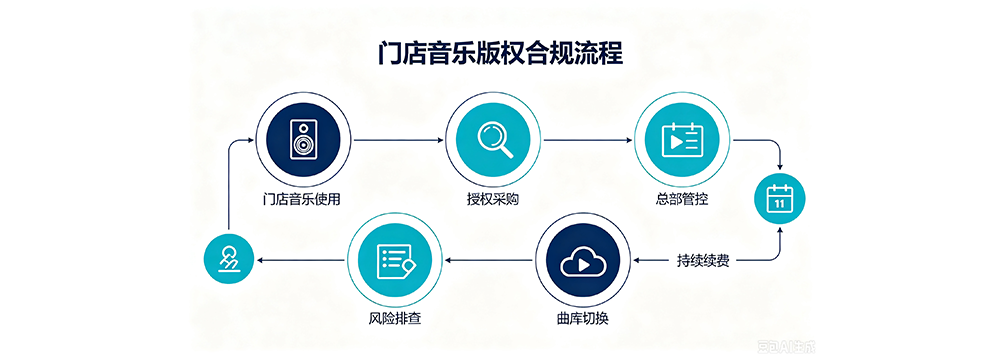
Addressing the characteristics of chain brands' scalability, standardization, and risk transmissibility, supplementary compliance key points that headquarters must master, filling the core blind spots missing in industry-standard manuals:
- Chain Risk Transmissibility: Single store infringement → Association batch evidence collection → Lawsuit against single store + brand headquarters → Enterprise Qichacha litigation records public → Affects franchise recruitment, financing, brand rating. Copyright risk is a systemic risk for chain brands, not a trivial matter for individual stores.
- Invalid Authorization High-Risk Areas: Personal subscriptions, direct signing with authors/record labels, free online music, AI music without authorization, and TV/radio reception are the five most common infringement sources for brand stores. Headquarters must uniformly prohibit them.
- Scenario Rights Isolation Principle: Offline store public broadcast, online livestream, short video background music, brand promotional videos, and store display screen background music - the five scenario rights are completely independent and not interchangeable. Authorizations must be purchased separately.
- Optimal Phased Compliance Path: Brand startup expansion period → Prioritize building StoreSound unified control system to lock in risk control backup capability; Brand scale stabilization period → Stack association copyright as needed to achieve full catalog compliance, adapting to brand development pace.
- Franchise System Compliance Control Key: Headquarters must incorporate music copyright compliance and unified catalog usage into franchise management systems, prohibit franchise stores from privately changing audio sources or downloading music, and fundamentally prevent infringement risks through both system and technology.
8. Future Trends in Commercial Music Copyright in China
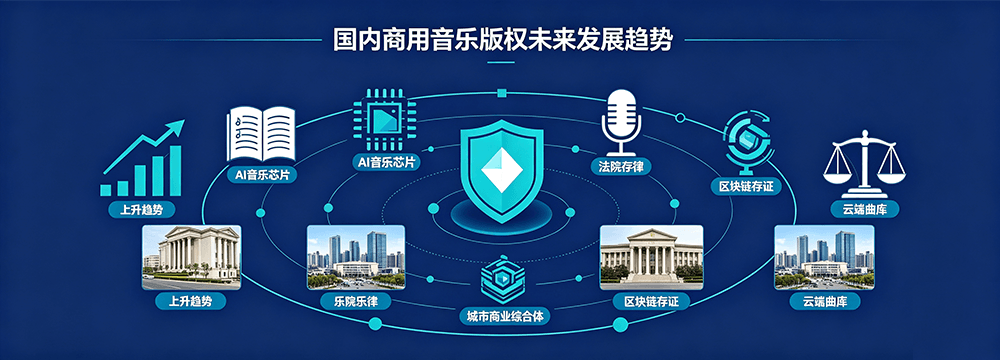
Commercial music public broadcast compliance, chain store copyright risks, copyright enforcement digitization; references (National Copyright Administration policy documents, Supreme People's Court judicial interpretations, collective management organization announcements, court precedents, industry research reports).
Against the backdrop of the national intellectual property power construction strategy, China's offline commercial music copyright protection is shifting from individual case enforcement in the past to normalized, digital, and full-chain supervision. Copyright protection continues to tighten, and store music compliance will gradually become a basic requirement for physical business operations.
8.1 Policy and Legislative Level: Legal Rules Continuously Refined, Protection Standards Comprehensively Elevated
After the revision of the Copyright Law, it explicitly distinguishes between songwriter/composer copyrights and recording producer neighboring rights. Playing background music in business venues requires balancing both songwriting performance rights and recording product public broadcast remuneration rights, rather than completing compliance with a single authorization. The National Copyright Administration's "Opinions on Accelerating the High-Quality Development of Copyright" continues to strengthen copyright regulatory guidance for business venues. Chain retail, restaurants, fitness, and commercial complexes are listed as key regulatory scenarios. Subsequent regulatory guidelines and industry billing standards for commercial background music will be further implemented, and the vague gray area will continue to shrink.
The punitive compensation system has been fully implemented. For chain entities that intentionally infringe or repeatedly infringe, courts may award 1-5 times punitive damages above the basic compensation, with the statutory compensation limit raised to 5 million RMB, significantly increasing the cost of infringement, forcing brands to take proactive compliance measures rather than remedying after litigation.
8.2 Rights Enforcement and Evidence Collection Level: AI Technology Popularized, Infringement Discovery Costs Significantly Reduced
In the past, rights enforcement relied mainly on manual on-site notarization; currently, rights holders widely use AI audio recognition, blockchain evidence preservation, and remote capture evidence collection technologies. They can monitor the use of background music in chain stores nationwide across cities, and batch fix infringement evidence in stores in different cities. Multi-store chains will be centrally batch-sued, no longer just scattered individual store lawsuits. Brand headquarters will directly bear the overall legal risks of the chain system. The threshold for initiating rights enforcement has been lowered, coverage has expanded, and the realistic possibility of "getting away with it" is increasingly remote.
8.3 Future Regulatory Plan for AI Music Copyright
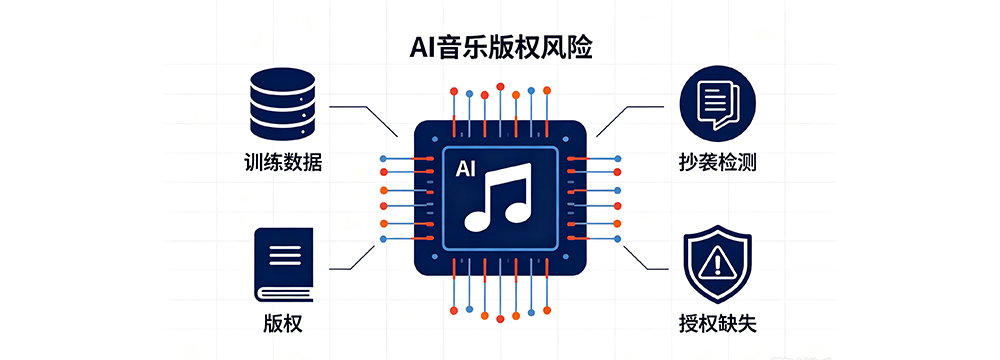
With the large-scale commercial implementation of AI-generated music, national regulatory authorities and copyright collective management organizations are accelerating the establishment of AI music copyright governance systems, introducing supporting rules and special regulatory measures for training data compliance, work ownership determination, commercial authorization boundaries, and offline public broadcast use.
- Top-level institutional building: The National Copyright Administration's "Opinions on Accelerating the High-Quality Development of Copyright" explicitly proposes to improve the copyright system for new formats of artificial intelligence, study the "authorize first, use later" rule for AI music training data, clarify the ownership of AI-generated music copyright and commercial use boundaries, and will introduce special industry guidelines to clarify the authorization requirements for offline commercial broadcast of AI music in stores, filling the current gap in industry rules.
- Special enforcement and rectification: The "Sword Net" special action has included AI copyright in key rectification categories, focusing on combating infringement acts such as large models grabbing copyrighted music for training without authorization, and enterprises directly using AI music with unclear ownership for commercial store broadcast. Subsequently, the use of AI music in offline physical stores will be included in normalized law enforcement monitoring, and AI music cannot become a safe haven for infringement.
- Industry collective management organization supporting rules implementation: MCSC and CAVCA are studying and introducing AI music filing and ownership verification guidelines; exploring filing and registration paths for "human-led, AI-assisted creation" musical works; for audio fully automatically generated by AI without human substantive creative contribution, it is explicitly not entitled to copyright protection, and commercial use must still be checked for substantial similarity with existing musical works to prevent plagiarism risks.
- AI-generated content mandatory labeling and technical evidence preservation: According to the requirements of the "Interim Measures for the Management of Generative Artificial Intelligence Services," AI-generated audio should implement content labeling obligations, promote the popularization of digital watermark and blockchain evidence preservation technologies, facilitate traceability in regulatory and judicial processes, and assist enterprises in verifying whether AI music has plagiarism or counterfeiting of existing musical works, reducing the difficulty of enterprise ownership verification.
Practical Implications for Chain Brands: In the future, using AI background music in stores cannot solely rely on the online authorization from AI tool platforms. You must verify that the authorization documents explicitly cover the public broadcast scenarios in offline business premises; simultaneously retain AI music source, authorization chain, and evidence preservation records to avoid batch litigation risks caused by model training infringement and work substantial similarity.
8.4 Judicial Adjudication Consensus Solidified: Business Operator's Responsibility Cannot Be Transferred Outward
A large number of effective judgments have formed stable judicial standards:
- Playing background music in business venues constitutes public performance behavior. Personal music app subscriptions and downloaded music have no commercial public broadcast validity at all;
- Whether it's a single store or a national chain, as long as music is played for business profit purposes, complete and valid commercial public broadcast authorization must be obtained.
8.5 Industry Development Direction: Music Copyright Authorization Becomes a Basic Compliance Item for Store Operation
In the future, store music copyright authorization will gradually become a basic compliance element for store operations, on par with fire safety and business licenses. For chain enterprises, copyright costs are no longer optional but a fixed cost that must be planned in the operating budget.
- New stores: Complete music copyright authorization during the opening stage, cannot open first and supplement copyright later;
- Existing chain stores: Need to complete full store copyright inspection, uniformly review authorization chains, authorization scope, and validity periods;
- Group headquarters need to uniformly control national store music copyright risks, prevent single store infringement from implicating the entire brand, causing batch lawsuits, brand public opinion, and high compensation.
8.6 Enterprise Response Recommendations
- Abandon the misconception of "using personal apps for store playback," verify whether authorization documents explicitly include both public performance rights and recording product public broadcast remuneration rights; when using AI music, additionally verify whether the authorization scope includes offline store public broadcast, and reject free AI audio with unclear ownership.
- Chain brands should prioritize commercial music authorization solutions that cover multi-store operations, provide complete authorization chains, and have clear contractual rights and responsibilities; when selecting AI music service providers, require service providers to bear the infringement backup responsibility for model training and generated content plagiarism.
- Incorporate copyright compliance into new store opening SOPs, include music copyright review in supplier access systems; include AI music in supplier risk review, and require provision of ownership, authorization, and evidence preservation materials.
- Regularly review authorization validity periods, properly archive contracts, and prevent hidden infringement risks caused by expired authorizations that go unnoticed.
References
- National Copyright Administration. Opinions on Accelerating the High-Quality Development of Copyright [EB/OL]. https://www.ncac.gov.cn/xxfb/tzgg/202507/t20250723_923374.html
- National Copyright Administration. China Copyright Protection and Development Status (2025) [R]. https://www.ncac.gov.cn/xxfb/tzgg/202606/P020260605627967417800.pdf
- CPC Central Committee, State Council. National Intellectual Property Power Construction Outline (2021-2035)
- State Council. "Fifteenth Five-Year Plan" for Intellectual Property Protection and Utilization [EB/OL]. Chinese Government Website
- Supreme People's Court. Interpretation on the Application of Punitive Damages in Civil Cases of Infringement of Intellectual Property Rights [EB/OL]. https://ipc.court.gov.cn/zh-cn/news/view-5627.html
- Copyright Law of the People's Republic of China (2020 Revision), Article 45, Article 54
- Music Copyright Society of China. 2025 Annual Work Report [EB/OL]. https://www.mcsc.com.cn/publicity/trends_1445.html
- China Audio-Video Copyright Association. Compilation of Judicial Cases on Music Use in Commercial Venues
- Beijing High People's Court. Adjudication Standards for Infringement of Intellectual Property Damages (Part of Musical Works)
- Discovered Law Firm. Research on Adjudication Logic and Industry Compliance of Music Copyright Disputes in Catering and Entertainment [EB/OL]. https://www.faxianlaw.com/cn/details/1289/533b3b652234ead4
- National Copyright Administration, Ministry of Culture and Tourism. Notice on Regulating the Copyright Market Order in the KaraOK Field
- Hunchun City People's Court. Coffee Shop Background Music Infringement Judgment (2026) [EB/OL]. http://www.jlpeace.gov.cn/jlscaw/dfdt/202605/ecfff2f2fb0f4df4b2b3c1b477bb26d3.shtml
- Commercial Music Authorization Solution Industry Market Research Report (2026)
- State Administration for Market Regulation, Ministry of Culture and Tourism. Network Music Service Compliance Guidelines (2025)
- China Copyright Association. Offline Commercial Space Music Copyright Compliance Guidelines